The Café Racer: From 1950s London to Modern Electronics
There’s something about a café racer that doesn’t age. Stripped down, leaned forward, aggressive in silhouette but restrained in detail — it’s a form that emerged from a very specific time and place, and somehow never stopped being relevant.
Here’s where it came from, how it evolved, and where it’s landed.
Post-War Britain and the Birth of the Ton-Up Boys
The café racer wasn’t designed. It was improvised — by young British working-class men in the early 1950s who had just enough money to buy a motorcycle and just enough rebellion in them to modify it.
Post-war Britain was rebuilding. Rationing was winding down. For the first time, motorcycles were within reach of the youth market, and brands like Triumph, Norton, and BSA were producing accessible parallel twins that were genuinely quick for their era. That combination — available machinery, restless energy, and a subculture built around American rock and roll — created something that nobody planned.
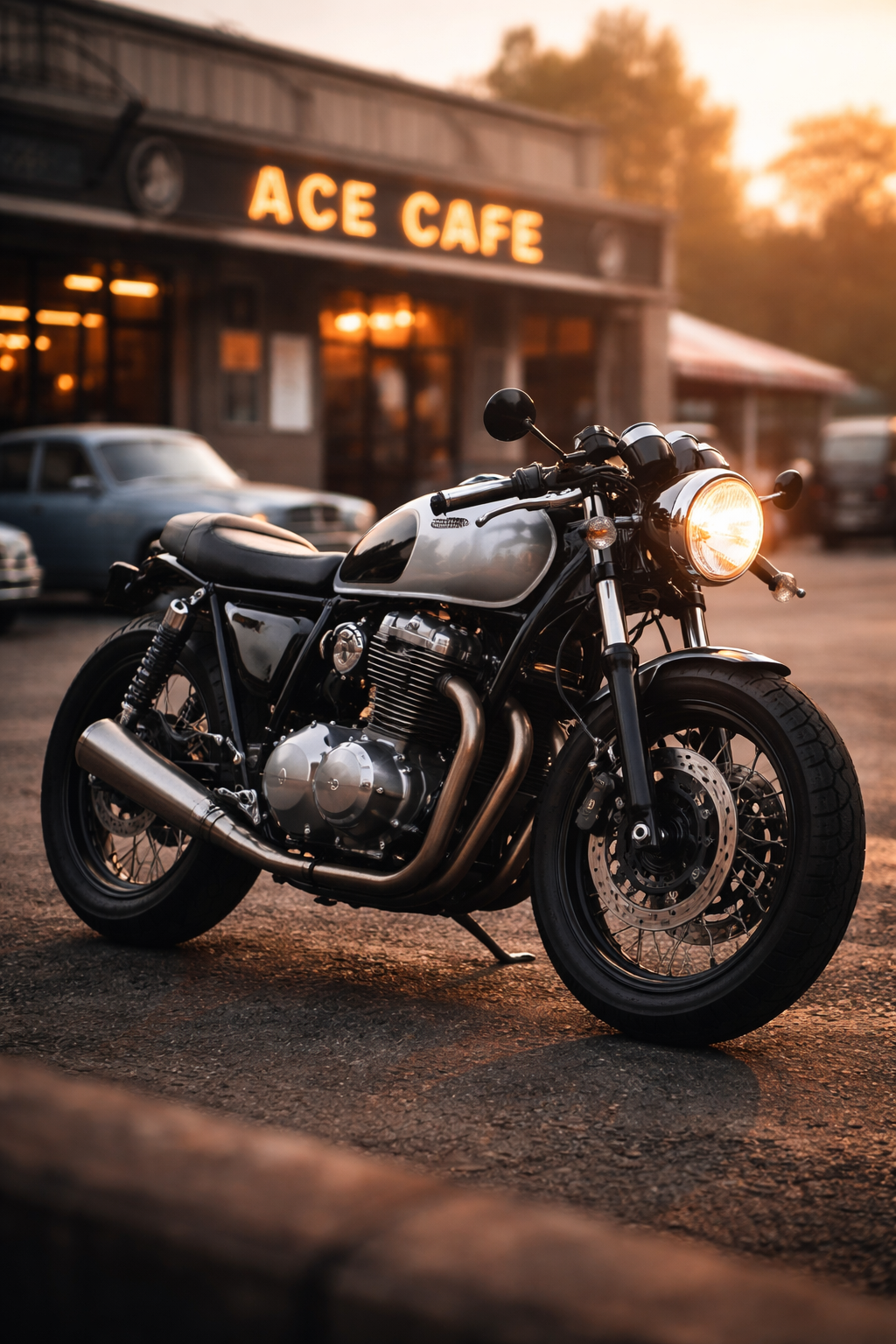
The Rockers, as they became known, gathered at transport cafés along London’s arterial roads. The Ace Café on the North Circular became the epicentre. These weren’t glamorous venues — they were working men’s greasy spoons that happened to have jukeboxes, which at the time were among the few places you could hear Elvis, Gene Vincent, or Chuck Berry in England. Rock and roll wasn’t on the radio. It lived in cafés and on the streets.
The ritual that defined the culture was simple: drop a coin in the jukebox, pick a song — about two minutes of running time — and race to a predetermined point and back before it ended. That two-minute sprint shaped everything. It demanded bikes that were fast and light and nimble, not comfortable. So the Rockers started removing things. Side panels, mudguards, chain enclosures — anything that added weight without adding speed came off. Clip-on handlebars replaced uprights. Rear-set footpegs replaced the stock position. The rider’s stance became aggressive, forward, race-derived.
The goal, always, was “the ton” — 100 miles per hour. At a time when that was genuinely difficult on a stock bike, it carried real weight. The Ton-Up Boys earned their name honestly.
The Machines: Triton, Bonneville, and the Featherbed Frame
The bikes of the early café racer era weren’t stock. The most revered were hybrids — none more so than the Triton, a combination of a Triumph engine dropped into a Norton Featherbed frame. Norton’s Featherbed was considered the best-handling chassis of the era, and shoehorning a Triumph twin into it produced something that outperformed both donor bikes. That kind of engineering pragmatism — use the best parts from wherever you can find them — became a permanent feature of café racer culture.
The Triumph Bonneville, introduced in 1959, became the platform of a generation. The Norton Manx and Matchless G50 provided racing inspiration. These weren’t factory café racers — they were production bikes that riders modified, stripped, and tuned toward a specific performance ideal. The aesthetic followed the function.
The Japanese Shift
By the mid-1970s, the British motorcycle industry had largely collapsed under the pressure of Japanese competition. Honda, Kawasaki, Yamaha, and Suzuki had arrived with bikes that were more reliable, more refined, and in many cases faster than what Britain was producing. The Rocker scene faded. The cafés remained, but the culture shifted.
What didn’t disappear was the impulse to modify. Japanese bikes became the new platform, and the Honda CB series — particularly the CB750 and its smaller sibling, the CB550 — became the foundation for a new generation of café racer builds.
Why the CB550 Specifically
The CB550 deserves its own mention. Introduced in the mid-1970s as a slightly more accessible alternative to the CB750, it hit a specific sweet spot that builders have appreciated for fifty years. The 544cc SOHC inline-four is smooth, characterful, and durable. The frame geometry is clean and well-proportioned for the café racer silhouette. It’s lighter than the CB750, easier to modify, and parts availability has only grown as the platform’s popularity increased. A good used CB550 can still be found in the $1,500–$4,000 range, making it one of the last affordable entry points into serious vintage custom building.
Where British bikes demanded fabrication skill and frame-swapping ingenuity, the CB550 offered something different: a complete, reliable package that responded well to thoughtful modification. Carb tuning, aftermarket exhaust, clip-ons, rear-sets, subframe modification for a custom seat — the bones were already there. You were refining, not rebuilding from scratch.
The Modern Renaissance
The café racer faded again in the 1980s as sportbikes arrived and the aesthetic shifted toward full fairings and raw power. It came back around 2009 with surprising force, driven by a combination of nostalgia, a growing custom motorcycle community, and a reaction against the visual noise and complexity of modern machines.
Today the movement has fully matured. Factory café racers from Triumph (the Thruxton R), Kawasaki (the Z900RS Café), BMW (the R Nine T Racer), and Ducati signal that this is no longer a fringe aesthetic — it’s a legitimate market segment. But the soul of the thing still lives in the garage builds.
Where It Gets Interesting: Modern Electronics on Vintage Platforms
The most significant evolution in contemporary café racer building isn’t in the chassis or the engine — it’s in the electrical system. Vintage bikes from the 1960s through the 1980s carry wiring harnesses that are, at this point, fifty years old. Corroded connectors, brittle insulation, overbuilt and under-organized systems that made sense when new but are now a liability.
The modern answer is a complete rewire using a control unit like the Motogadget M-Unit. This is a German-made programmable electrical brain that replaces the rats nest of relays, fuses, and discrete components under the seat with a single consolidated unit. It uses solid-state circuit breakers instead of fuses, manages all lighting circuits, integrates an alarm, and in its M-Unit Blue variant, connects to your smartphone via Bluetooth — giving you keyless RFID ignition, ride logs, fault diagnostics, and maintenance alerts on a bike that was designed in 1974.
Paired with the M-Unit is the shift to momentary contact switches on the handlebars. Traditional motorcycle switches are toggle or rocker style — physically large, visually cluttered, and prone to failure in old Hondas. Momentary switches, machined from billet aluminum and barely larger than a thumb tip, replace entire switch housings with clean, minimal inputs that the M-Unit interprets and routes. A single switch cluster can manage headlight high/low, turn signals, horn, and starter — with nothing visible from the outside but a clean set of machined buttons.
LED lighting completes the picture. Modern LED headlights draw a fraction of the current of incandescent bulbs while producing dramatically better output — which matters on a vintage charging system that was never designed to handle accessory loads. LED tail and turn signals shrink to almost nothing, clean up the rear end visually, and last indefinitely. The electrical load reduction also lets builders run smaller lithium batteries — further reducing weight and clearing space under the seat.
The result, done well, is a bike that looks period-correct from twenty feet but carries the electrical reliability and diagnostic capability of a modern machine. That’s the tension café racer builders have always navigated: authentic form, modern function.
Why It Endures
The café racer is, at its core, a philosophy more than a style. It’s about removing what doesn’t need to be there. About building something faster and lighter and more honest than what you started with. About a rider’s relationship with a machine that they understand completely — because they built it.
That ethos started on the North Circular Road in 1950s London, transferred to Japanese platforms in the 1970s, and is being expressed today through Motogadget controllers and billet aluminum switchgear on fifty-year-old Honda inline-fours.
The specifics change. The impulse doesn’t.
Related Posts

Sign up with your email and always get notifed of Avada Lifestyles latest news!