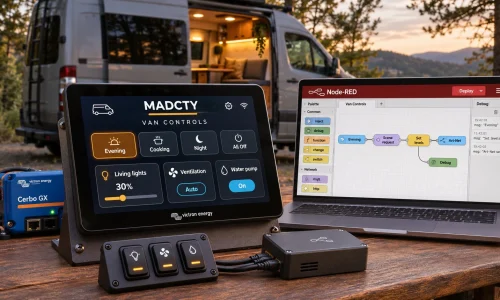
Understand how your van’s lighting and controls work, from a simple switch to coordinated scenes on a GX Touch. This beginner course explains why the proposed system uses Node-RED, Art-Net and DMX, then follows a command all the way to the light.
Across 37 lessons in seven stages, you will compare design options, practise with safe demonstration flows, distinguish the command path from the power path, and learn how to isolate faults instead of guessing.
The worked design includes seven lighting zones, a Le Mans fan and a shared 12V supply serving lights, fridge, water pump and grey-tank heating. Normal living-area use is considered separately from allowed maximum loads and starting transients.
What you will learn
- Explain the role of each component and why it was proposed.
- Read a DMX address map and understand what an Art-Net message carries.
- Follow a scene from a user request through Node-RED to a decoder.
- Plan manual control, overrides and future assistant requests.
- Measure, commission and troubleshoot one part at a time.
Start at the beginning; no prior knowledge of Node-RED, Art-Net or DMX is assumed. Guided practice and lesson self-checks are included. Each stage ends with a five-question checkpoint quiz: score at least 80% (four correct answers out of five) on each of the seven quizzes to pass the course. Quizzes are untimed, with answer explanations, review and up to 10 retries per quiz. Use the feedback to revisit the relevant lesson and explain the principle in your own words. Course completion records learning progress; it does not certify an electrical installation.
Curriculum
- 7 Sections
- 37 Lessons
- Lifetime
- 1 · What we want the van to do3 Items
- 2 · From a simple switch to coordinated control3 Items
- 3 · Why this architecture3 Items
- 4 · Meet the components6 Items
- 4.107 · Recognize the boxes, the software and the messages
- 4.208 · Meet Node-RED before writing a rule
- 4.309 · Meet DMX as a numbered list of lighting levels
- 4.410 · Meet Art-Net and look inside a lighting message
- 4.511 · What RGB plus CCT actually means
- 4.6Checkpoint 4 · Understand Node-RED, DMX and Art-Net5 Questions
- 5 · Follow one complete scene4 Items
- 6 · Build understanding through guided practice14 Items
- 6.115 · First guided flow: send a word and see it arrive
- 6.216 · Second guided flow: turn a scene request into settings
- 6.317 · Dimming, white mixing and honest colour labels
- 6.418 · DMX addresses are mailbox numbers
- 6.519 · Ethernet carries Art-Net; DMX carries the next step
- 6.620 · Why the DMX cable is a chain
- 6.721 · Volts, amps, watts and time
- 6.822 · Design for the way the van is used
- 6.923 · Size the shared positive as well as the channels
- 6.1024 · Fuses, terminals and heat are part of the design
- 6.1125 · One converter or separate supplies
- 6.1226 · Measure the circuit without changing it
- 6.1327 · Commission one small system before seven zones
- 6.14Checkpoint 6 · Apply the principles safely5 Questions
- 7 · Extend and troubleshoot11 Items
- 7.128 · Scenes, manual overrides and sensible priorities
- 7.229 · The owned Le Mans fan is the starting point
- 7.330 · Manual, off and auto must have definite meanings
- 7.431 · Sensors, hysteresis and stale information
- 7.532 · Fridge, pump and tank heat on the 12V schedule
- 7.633 · Add an assistant as another source of requests
- 7.734 · Manual lighting and the failures it survives
- 7.835 · Restart behavior and lost messages
- 7.936 · Troubleshoot by dividing the problem
- 7.1037 · Capstone: hand over a system someone can understand
- 7.11Checkpoint 7 · Troubleshoot and extend the system5 Questions
Instructor