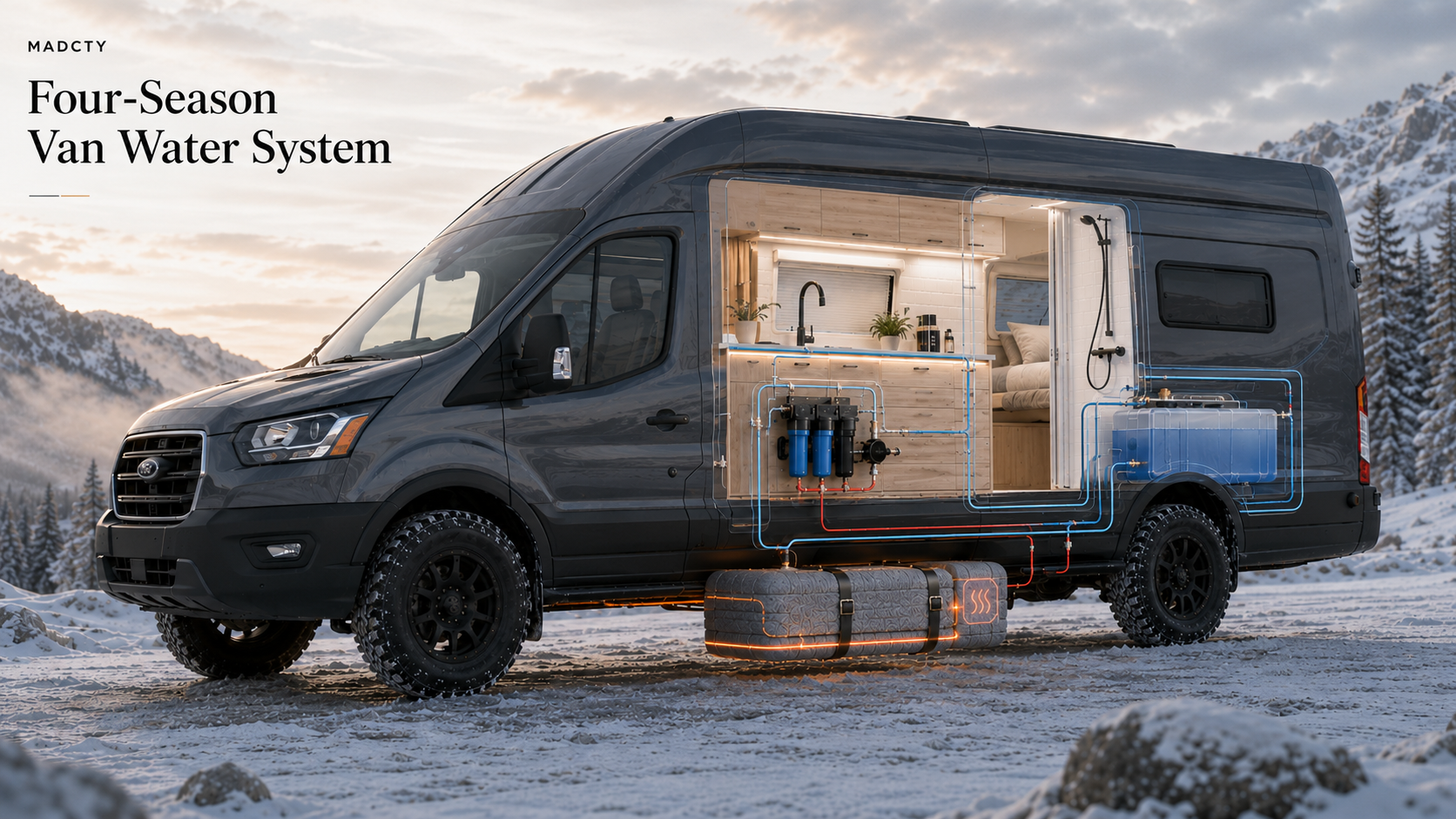
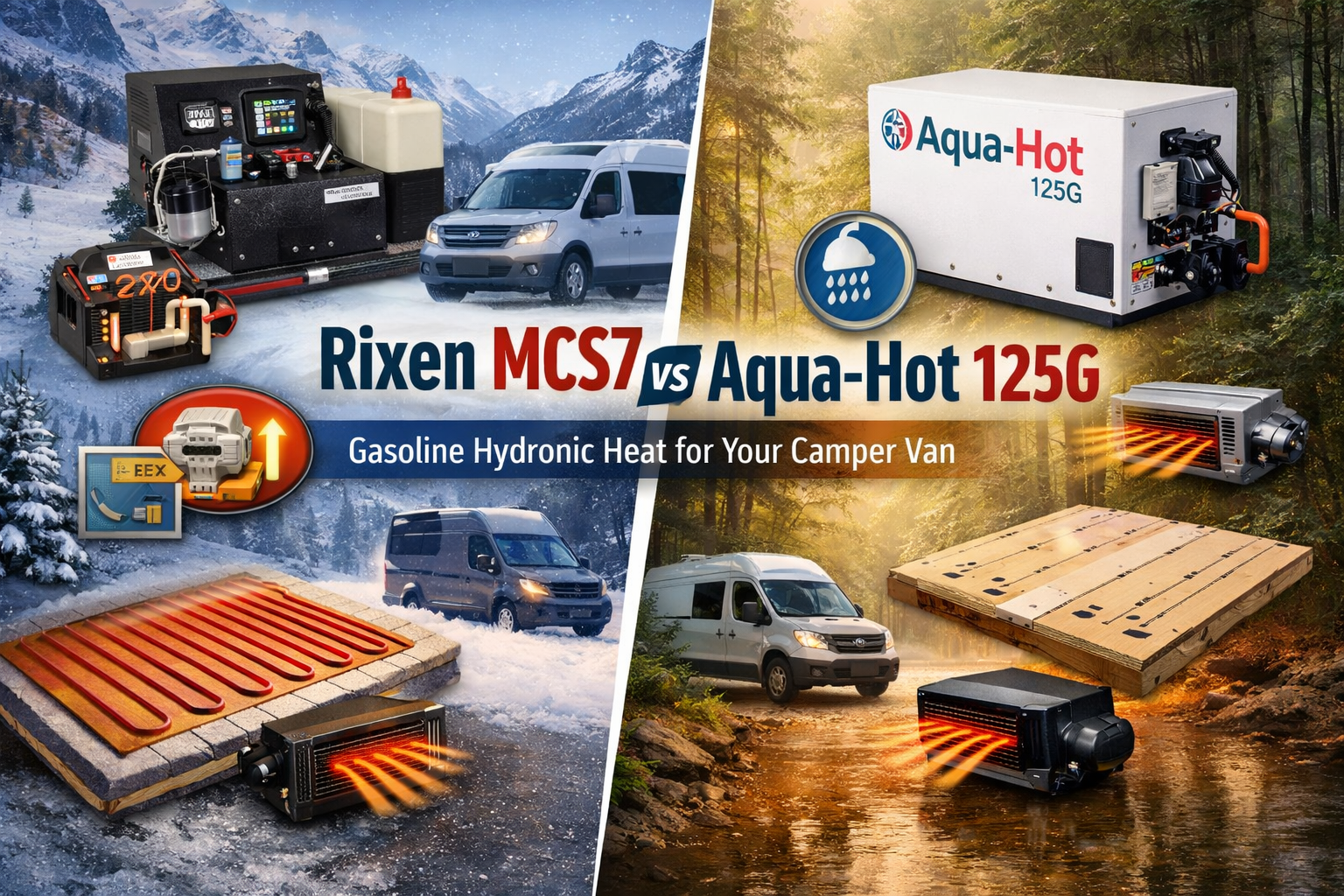
Gasoline Hydronic Heat for a 4-Season Transit Van
How Aqua-Hot, Rixen, and Timberline compare for real winter + real summer comfort
When you’re building a serious four-season camper van — one that will spend Canadian-prairie winters at –35 °C and Southwestern summers over 120 °F — your heating and hot-water system isn’t just another feature: it defines comfort, safety, and independence.
You want:
- Gasoline fuel (so no propane hassles),
- Hydronic heat for radiant floors + air fan coils,
- Hot water for sink + shower,
- Engine pre-heat / waste-heat capture for cold starts,
- A system that just works, reliably, under extreme conditions.
Below is a deep yet readable comparison of three leading gasoline-capable hydronic systems — what they are, how they work, and which might be right for your Transit AWD build.
What Is Hydronic Heating? (Quick Primer)
Hydronic heating means circulating hot fluid (usually a glycol-water mix) through loops and heat exchangers that:
- Warm the air (via fan coils),
- Warm the floor (radiant heat),
- Heat domestic hot water via a heat exchanger.
It’s quiet, evenly distributed, and much more comfortable than typical forced-air furnace heat.
System #1 — Aqua-Hot 125G (Gasoline)
Complete, proven, all-in-one
What it is: A complete hydronic system designed specifically for Class-B/RV use that provides both interior heat and continuous hot water from one integrated unit. The gasoline burner operates off your van’s fuel tank.
Key strengths
- All-in-one: One packaged unit handles heat + hot water.
- Continuous hot water: Around 110–120 °F at ~0.8 GPM — enough for showers and dishes.
- Multiple zones: Attached fan coil points and heat locations.
- Quiet & comfortable: Smooth hydronic heat with balanced distribution.
- High altitude ready: Automatic altitude compensation.
Limitations
- No direct engine pre-heat or waste heat capture option.
- External combustion box adds some plumbing complexity.
Ideal for: Builders who want a well-supported, turnkey hydronic system without piecing components together.
System #2 — Rixen MCS7 + S-3 Gasoline Furnace Kit
Modular & engine-friendly
What it is: A hydronic kit using an Eberspächer Hydronic S3 gasoline heater — a flexible burner and controller package that you integrate with your loops, fan coils, and hot water exchanger.
Key strengths
- Gasoline hydronic core: Uses a proven gasoline-burning heater.
- Includes: Controller, coolant pump, plumbing, and hydronic heater base.
- Engine heat integration: Optional kits can capture waste heat or pre-heat engine coolant.
- Flexibility: Design your radiant floor, air heat exchangers, and controls.
Limitations
- Not a single packaged system — requires custom loop and accessory planning.
- Control zoning requires layout planning.
Ideal for: DIY builders who want flexibility and engine heat integration.
System #3 — Timberline 2.0 Gasoline Hydronic System
Modern integrated hydronic with rich feature set
What it is: A newer hydronic heating and hot water system for RVs that can be ordered in a gasoline version. It includes internal plumbing, digital controls, hydronic loops, and dedicated heat exchangers.
Key strengths
- All-in-one hydronic + hot water: Like Aqua-Hot, but with modern controls.
- Fuel flexibility: Gasoline or diesel options.
- Quiet operation: Designed for low noise.
- Supplemental electric heat: Built-in electric element for shore power boost.
- Zoning & controls: Built-in touchscreen and multiple heat zones.
Limitations
- Less documentation/support in the aftermarket than Aqua-Hot.
- Engine waste-heat capture not commonly integrated.
Ideal for: Builders who want an integrated system with modern controls.
Side-by-Side: What They Each Do Best
| System | Fuel | Complete System | Hydronic Floor | Hot Water | Engine Pre-Heat/Waste Heat | Notes |
|---|---|---|---|---|---|---|
| Aqua-Hot 125G | Gasoline | Yes | Yes | Continuous | No | Turnkey and proven |
| Rixen MCS7 + S-3 | Gasoline | Partial (kit) | Yes | Plate HX | Optional | Flexible but custom |
| Timberline 2.0 | Gasoline or Diesel | Yes | Yes | Continuous | No | Modern controls |
Cold Reality Check — Does ~17k BTU Work?
In real –35 °C winter conditions with a well-sealed, well-insulated van, hydronic systems in the ~15–17 kBTU class are sufficient provided:
- Your insulation and air sealing are excellent,
- Your radiant floor is designed correctly, and
- Your fan coils are placed for good air circulation.
Hydronics shine because they deliver smooth, even heat — no hot/cold spikes.
Installation & Support Comparison
| System | Ease of Purchase | Documentation | After-Sales Support | Installation Complexity |
|---|---|---|---|---|
| Aqua-Hot 125G | High | Strong | Broad | Moderate |
| Rixen MCS7 + S-3 | High | Moderate | Good | Higher (custom loops) |
| Timberline 2.0 | Moderate | Moderate | Developing | Moderate |
Which System Is Right for You?
Best All-Around: Aqua-Hot 125G — proven, strong support, minimal customization.
Best Flex + Engine Heat: Rixen MCS7 with floor kit, fan coils, and engine heat integration.
Best Modern Interface: Timberline 2.0 — modern controls with integrated hot water and zones.
Final Thoughts
None of these systems are “wrong” — they all deliver comfortable heat and hot water even in extreme conditions. But they differ in how they integrate, how much assembly they require, and how they fit into your build philosophy.
Choose the one that aligns with your priorities: turnkey simplicity, custom flexibility, or modern control and zoned comfort.
Related Posts




Sign up with your email and always get notifed of Avada Lifestyles latest news!