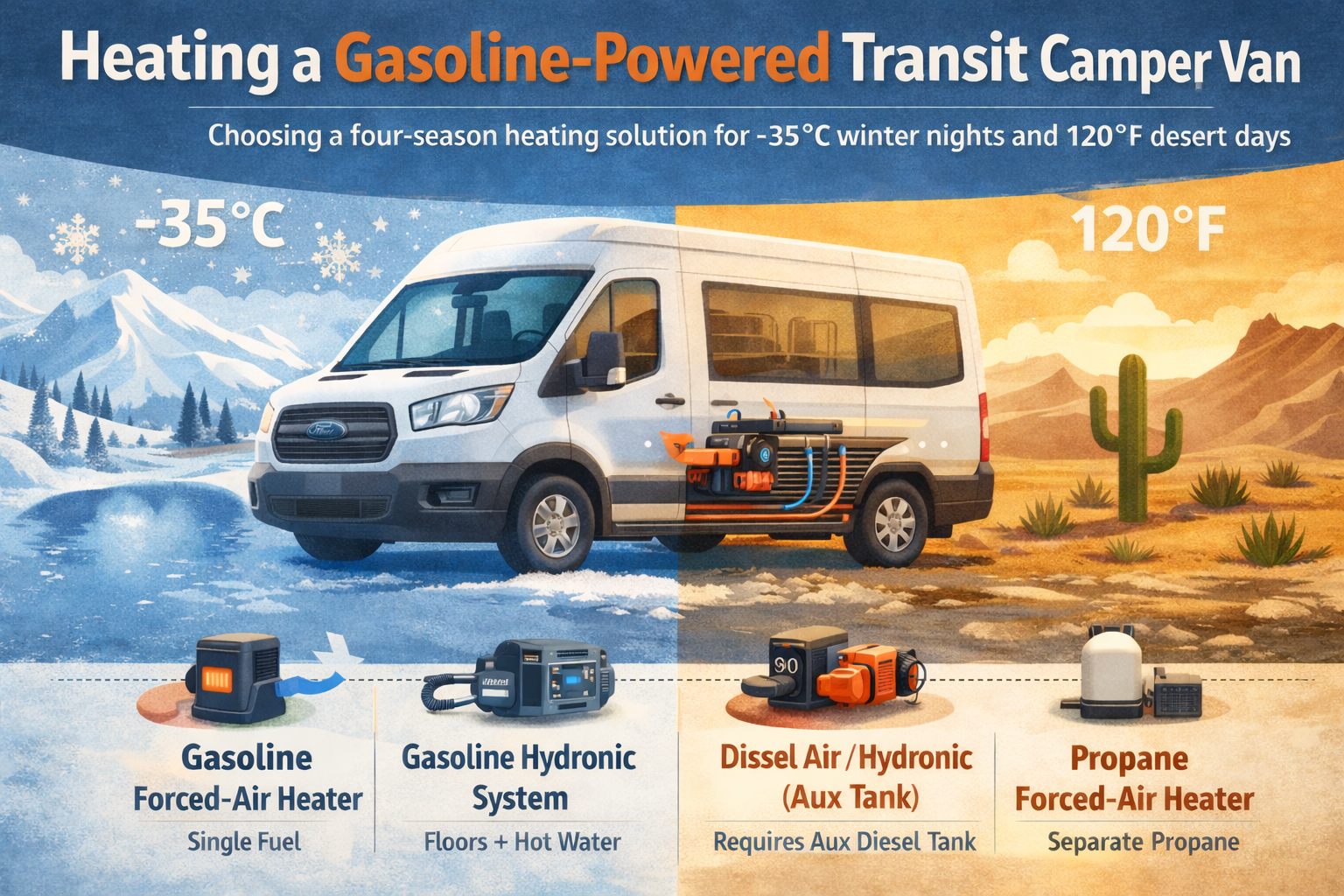
Heating a Gasoline-Powered Transit AWD Camper Van for True Four-Season Use
Choosing the right system for -35°C (-31°F) prairie nights and 50°C (120°F) desert days
Building a true four-season camper van is less about insulation alone and more about how you create, distribute, and manage heat. Van conversion heating is crucial, especially in a Ford Transit AWD High Roof Extended with a 3.5L EcoBoost gasoline engine, where heating choices differ meaningfully from diesel-based builds. Fuel type affects system availability, complexity, serviceability, and how well your van performs at the extremes—from -35°C (-31°F) Saskatchewan winter nights to 120°F (49°C) Arizona days.
This article is a standalone guide to realistic heating options for a gasoline-powered Transit. It assumes a well-insulated shell (walls, ceiling, thermal breaks, tight air sealing, insulated window coverings). Insulation reduces demand; it doesn’t eliminate the need for a robust heating strategy—especially when freeze protection, condensation control, and long-term reliability matter.
What extreme cold really demands
At -35°C, heating becomes structural rather than optional. You are solving for:
- Safe, quiet overnight heat without draining batteries
- Freeze protection for plumbing, tanks, pumps, and valves
- Condensation control to avoid mold and long-term damage
- Thermal stability for batteries, sealants, and finishes
In hot climates, heating fades into the background—but it still matters for cold desert nights, shoulder seasons, and elevation changes. The right system handles both ends of the spectrum gracefully.
With a gasoline engine, the core design decision is simple:
Do you heat from the van’s existing gasoline supply, or introduce a second fuel system?
Heating options for a gasoline Transit AWD
1) Gasoline forced-air heaters
What they are: Compact furnaces that burn gasoline and deliver hot air via ducting—purpose-built for vans and overland vehicles.
Common examples:
- Webasto Air Top (gasoline variants)
- Espar Airtronic B-series (gasoline)
Strengths
- Single-fuel simplicity: Taps the Transit’s gasoline tank—no auxiliary fuel to manage.
- Excellent cold-weather performance: Designed for extreme environments when installed correctly.
- Low electrical draw: Ideal for overnight, off-grid heating.
- Fast warm-up: Direct air heat is immediately noticeable.
Limitations
- Air heat only: No inherent floor warmth or domestic hot water.
- Noise: Fan noise is present, though generally smoother than diesel systems.
- Ventilation required: Dry heat without airflow management increases condensation risk.
Best fit: The cleanest, most pragmatic primary heat source for a gasoline Transit.
2) Diesel forced-air heaters (with auxiliary tank)
What they are: Widely used diesel air heaters adapted to a gasoline van by adding a separate diesel tank.
Strengths
- Proven, globally supported technology
- Strong heat output per litre of fuel
Tradeoffs in a gasoline van
- Second fuel system: Extra tank, fill point, and winter fuel considerations.
- Space and complexity: Packaging and maintenance overhead.
- Operational friction: Two fuels to track year-round.
Best fit: Rarely optimal unless paired intentionally with a diesel hydronic system.
3) Gasoline hydronic systems (radiant floors, fan coils, hot water)
What they are: A gasoline-fired boiler heats a glycol loop that can serve multiple loads:
- Fan coils (forced air heating)
- Radiant floor loops (true warm floors)
- Domestic hot water via heat exchanger
- Optional engine-coolant integration
Example:
- Rixen’s Enterprises gasoline hydronic systems
Strengths
- Highest comfort ceiling: Even heat distribution and warm floors.
- Integrated hot water: One system for cabin heat and showers.
- Excellent freeze protection potential: Heat can be targeted where plumbing lives.
- Single fuel: Uses gasoline—no auxiliary diesel tank required.
Limitations
- Cost: Significantly more expensive than forced-air heaters.
- Complexity: Pumps, expansion tanks, glycol management, and controls.
- Install time: Requires careful layout and service access.
Best fit: Premium, no-compromise four-season builds with heated floors and full plumbing.
4) Engine-coolant heat exchangers
What they are: Systems that capture waste heat from the EcoBoost engine to warm the cabin or hydronic loop while driving.
Strengths
- Free heat while driving
- Engine pre-heat capability in winter
Limitations
- No heat when parked unless paired with a heater or boiler
- Careful integration required to avoid service issues
Best fit: A supplemental system, especially effective alongside hydronic heat.
5) Propane forced-air heaters
What they are: Sealed-combustion propane furnaces commonly used in RVs.
Strengths
- Clean, reliable combustion
- Fuel separation from vehicle systems
Limitations
- Introduces an additional fuel alongside gasoline
- Cold-weather vaporization challenges at extreme lows
- No inherent floor or water heating
Best fit: Viable, but less compelling when gasoline heaters are available.
6) Electric resistance heat
What it is: Space heaters, electric mats, or tank heaters converting electricity directly into heat.
Strengths
- Excellent on shore power
- Useful as backup or localized freeze protection
Limitations
- Impractical off-grid at extreme cold
- High battery consumption
7) Heat pumps / mini-splits (heating mode)
What they are: Air-conditioning systems that reverse to provide heat efficiently—within limits.
Strengths
- Very efficient in mild temperatures
- Excellent synergy with cooling for hot climates
Limitations
- Performance drops sharply in deep cold
- Not suitable as the sole heat source for -35°C conditions
Quick comparison
| System | Fuel | Best Use | Main Tradeoff |
|---|---|---|---|
| Gasoline forced-air | Gasoline | Simple, efficient primary heat | No floors or hot water |
| Gasoline hydronic | Gasoline | Floors, hot water, zoning | Cost and complexity |
| Diesel forced-air | Diesel | Proven technology | Auxiliary fuel system |
| Propane forced-air | Propane | Clean, reliable heat | Additional fuel logistics |
| Electric resistance | Electric | Shore power and backup | Battery intensive |
Choosing the right path
For a gasoline-powered Transit AWD intended to thrive in real winter conditions:
- Most practical: A gasoline forced-air heater paired with good ventilation and targeted freeze protection.
- Most complete: A gasoline hydronic system delivering radiant floors, fan coils, and integrated hot water.
Diesel and propane systems still work, but they add complexity without unique advantages for a gasoline van. Electric heat and heat pumps excel as supplements—not primary solutions—in extreme cold.
The right heating choice turns a well-insulated shell into a livable, resilient home, whether parked on the prairies in January or settling in after a desert sunset.
Further Reading & Manufacturers
For readers who want to explore specific heating systems in more detail or review manufacturer specifications directly, the following North American suppliers are authoritative reference points for gasoline-compatible camper van heating solutions:
- Webasto– Industry-leading gasoline air heaters and engine coolant heating solutions for vans and overland vehicles.
https://www.webasto-group.com/en-us/ - Espar (Eberspächer) – Gasoline Airtronic heaters widely used in cold-climate camper and expedition builds.
https://www.eberspaecher-na.com/ - Rixen’s Enterprises – Complete gasoline hydronic systems supporting radiant floors, fan coils, hot water, and engine integration.
https://rixens.com/ - Propex Heating – Sealed-combustion propane furnaces commonly used in camper vans and compact RVs.
https://www.propexheatsource.com/ - Cruise N Comfort – Compact heat pump and HVAC systems often adapted for premium van and marine installations.
https://www.cruisencomfortusa.com/
This Manufacturer documentation allows you to confirm operating temperature ranges, fuel compatibility, electrical requirements, and installation considerations before selecting a heating system for your specific climate and use case.
Related Posts



Sign up with your email and always get notifed of Avada Lifestyles latest news!